

EMA Dashboard KPI Dictionary
- 1. Integrity & Call Health
- 1.1 KPIs
- 1.2 Calls Per Second
- 1.3 Attempt Violation
- 1.4 Performance Over Period
- 1.5 Short Call Duration
- 1.6 ASR (%) Heatmap
- 2. DID Efectiveness
- 2.1 Outbound DIDs
- 2.2 Destination DID
- 2.3 Early Media
- 2.4 Early Media Ranking
- 2.5 Connected & Non Connected
- 2.5 Top Connected & Non Connected Numbers
1. Integrity & Call Health
1.1 KPIs

1.2 Calls per Second

| KPI | Details |
| Peak Calls Per Seconds | Highest number of call attempts recorded in a single second. |
| Average Calls Per Second | Average number of successfully connected calls per second |
1.3 Attempt Violation

KPI | Details |
Acceptable | Fewer than 10 failed attempts to unique destination numbers. Considered normal behavior. |
Low Risk | 11–20 failed attempts to unique destination numbers. Slightly abnormal pattern. |
Moderate | 21–30 failed attempts to unique destination numbers. Potential suspicious activity. |
High | 31–40 failed attempts to unique destination numbers. High risk behavior. |
Major | 41–50 failed attempts to unique destination numbers. Very likely fraud-related activity. |
Critical | More than 50 failed attempts to unique destination numbers. Strong indication of fraudulent activity. |
1.4 Performance Over Period

KPI | Details |
Attempted Calls | Total number of call attempts generated in the system, regardless of whether the call was answered or failed. |
Connected Calls | Total number of calls that were successfully answered. A non-null Answer Stamp indicates the call was connected. |
Failed Calls | Total number of calls that did not end successfully. Any hangup cause different from 200 is considered a failed call. |
Short Call Duration
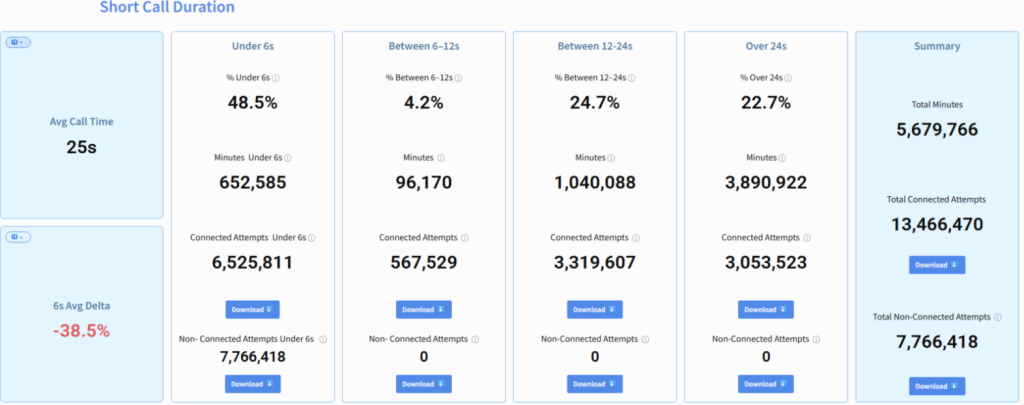
Less than 6 seconds | |
KPI | Details |
Percentage | Percentage of connected calls lasting less than 6 seconds. |
Minutes | Total billed minutes generated by calls shorter than 6 seconds, applying 6-second rounding rules. |
Connected | Number of successfully connected calls under 6 seconds. |
Non-Connected | Number of failed calls under 6 seconds. |
Between 6 and 12 seconds
KPI | Details |
Percentage | Percentage of connected calls lasting between 6 and 12 seconds. |
Minutes | Total billed minutes for calls between 6 and 12 seconds, applying billing increments. |
Connected | Number of successfully connected calls between 6 and 12 seconds. |
Non-Connected | Number of failed calls between 6 and 12 seconds. |
Between 12 and 24 seconds. | |
KPI | Details |
Percentage | Percentage of connected calls lasting between 12 and 24 seconds. |
Minutes | Total billed minutes for calls between 12 and 24 seconds after rounding to billing increments. |
Connected | Number of connected calls between 12 and 24 billed seconds. |
Non-Connected | Number of failed calls between 12 and 24 billed seconds. |
1.6 ASR (%) Heatmap

KPI | Description |
ASR | Percentage distribution of successfully connected calls (Hangup Cause = 200) relative to the overall total within the selected dataset. Used for heatmap visualization to compare performance across dimensions such as carrier, destination, time period, or route. |
2.DID Efectiveness
2.1 Outbound DIDs

KPI | Description |
T+ Validated Numbers | Total number of unique DID numbers that generated a successful SIP response (200 OK) and required no further action (Ema Disposition = “No Action”). These are considered validated and operational numbers. |
Unvalidated Numbers | Total number of unique originating addresses that generated a successful SIP response (200 OK) but are not classified as validated DIDs. Represents numbers that have activity but are not confirmed as validated Teams+ DIDs. |
2.2 Destination DID

KPI | Description |
Calls Connected | Total number of successfully connected calls (SIP 200 OK) where no blocking or special action was applied (Ema Disposition = “No Action”). Represents normal completed calls to destination DIDs. |
Unique Number | Total number of unique destination DID numbers that received successfully connected calls without any action or blocking applied. |
KPI | Description |
Calls Connected | Total number of calls that received SIP 200 OK but were intercepted by the iOS 26 call screening feature (automated call screening message). |
Unique Number | Number of unique destination DIDs where calls were answered but redirected to the iOS 26 automated screening message. |
KPI | Description |
Calls Connected | Total number of calls that received SIP 200 OK but were identified as voicemail by the detection system. These calls did not reach a live user. |
Unique Number | Total number of unique destination DIDs where calls were answered but routed to voicemail instead of a live person. |
2.3 Early Media

KPI | Description |
Attempted | Total number of call attempts rejected with SIP 403 Forbidden. Indicates the carrier understood the request but refused it, commonly due to blocking rules, permissions, or configuration issues. |
Unique Destination Number | Number of unique destination numbers that returned a 403 Forbidden response. |
KPI | Description |
Attempted | Total number of calls rejected due to timeout (SIP 408). Indicates no response was received within the expected time window. |
Unique Destination Number | Number of unique destination numbers that experienced timeout errors. |
KPI | Description |
Attempted | Total number of calls rejected because the destination line was busy (SIP 486). The endpoint is actively engaged on another call. |
Unique Destination Number | Number of unique destination numbers that returned a busy response. |
KPI | Description |
Attempted | Total number of calls rejected due to service unavailability (SIP 503). Usually related to carrier overload, maintenance, or temporary infrastructure issues. |
Unique Destination Number | Number of unique destination numbers affected by service unavailability errors. |
KPI | Description |
Attempted | Total number of calls rejected with 404 Not Found. Indicates the destination number or endpoint does not exist or is incorrectly formatted. |
Unique Destination Number | Number of unique destination numbers that returned a 404 error. |
KPI | Description |
Attempted | Total number of calls rejected due to gateway timeout (SIP 504). Indicates a routing or upstream server response issue. |
Unique Destination Number | Number of unique destination numbers affected by gateway timeout errors. |
KPI | Description |
Attempted | Total number of calls rejected because the endpoint was temporarily unavailable (SIP 480). The destination may be offline, out of coverage, or powered off. |
Unique Destination Number | Number of unique destination numbers that returned an unavailable response. |
KPI | Description |
Attempted | Total number of calls terminated with SIP 487. Indicates the call was cancelled before being answered, often because the caller hung up. |
Unique Destination Number | Number of unique destination numbers involved in cancelled call attempts. |
2.4 Early Media Ranking
KPI | Description |
Attempts | Displays the number of Early Media attempts for the destination number ranked in position 1. This metric highlights the top-ranked number based on Early Media activity within the selected time range. |
Unique Destination Number | Counts the unique destination number that holds the top ranking (Rank = 1) based on Early Media occurrences. Used to identify which number generated the highest Early Media activity. |
2.5 Connected & Non Connected

KPI | Description |
Connected Calls | Total number of successfully connected calls. Hangup Cause 200 indicates the call was answered. |
Non-Connected Calls | Total number of calls that were not successfully connected. Includes all failed, rejected, cancelled, or unreachable attempts. |
2.6 Connected & Non Connected Numbers
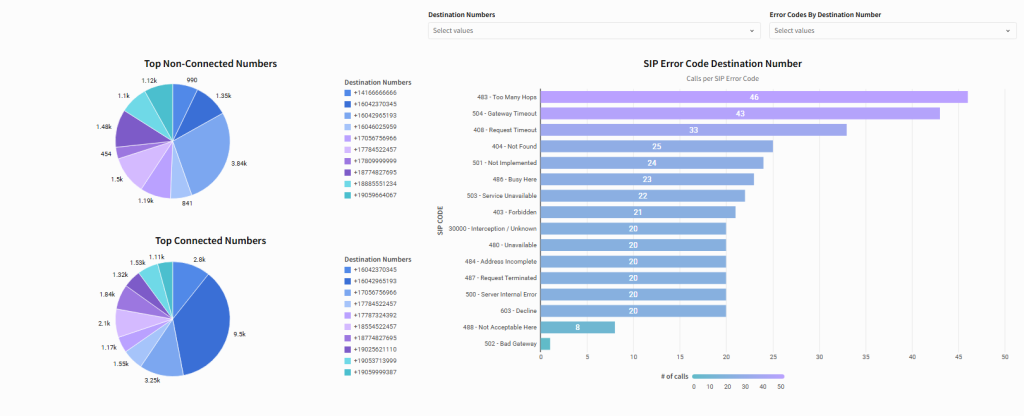
KPI | Description |
Top Connected Numbers | Ranks destination numbers based on the number of successfully connected calls. Identifies the top-performing numbers by connection volume. |
Top Non-Connected Numbers | Ranks destination numbers based on the number of failed or non-connected calls. Helps identify problematic or low-performance destinations. |
SIP Error Code Destination Number | Total number of call attempts grouped by SIP error code and destination number. Used to analyze attempt distribution and identify recurring SIP error patterns per destination. |